

A Message to Concerned Citizens of Seal Beach
April 16, 2012 by Wilm
Filed under Events, Green Issues, Local News
Comments Off on A Message to Concerned Citizens of Seal Beach
(What’s Up In Seal Beach received the following note from the group of residents in opposition to the planned over-development of the old power plant property at Ocean and 1st street.)
SEAL BEACH NEIGHBORS: Please attend the DWP meetings at the City Council meeting tonight! The DWP property has been on the high priority list of the Coastal Commission for 40 years!
AT 6 p.m. tonight there is an Environmental Quality Control Board meeting -Monday April 17th tonight 6:PM
AT 6:30 p.m tomorrow night there is a DWP Advisory Committee Meeting – Tuesday April 17th 6:30 PM
THE MAJORITY OF THE CITY COUNCIL DOESN’T BELIEVE THAT MOST OF THE CITIZENS ARE AGAINST THIS PROJECT !
In 2003 THe DWP Ocean front acres were bought for $4,000,000. When the Bay City Partners, bought the land they knew it was Zoned 70% Open Space/30% Visitor Serving Commercial …NOW THEY WANT TO CHANGE IT.
They are trying to invalidate that zoning and reduce the open space and adversely impact the remaining space…not with “Visitor Serving Commercial development ….but with densely packed row housing.
The Developers get:
* $900,000 from the city…which we will pay for.
* 48 row houses densely packed end to end on and a severe reduction of the park land (To the last bluff on Southern California Coast)
* 25′ narrow lots
* Costly concessions from us the taxpayers (We pay the developer $900,000 to lease the driveway to 1st Street lot? We get no parking fees for that “gift”
Is it right to grant a zone change to developers just so they can make more money ?
Seal Beach Residents & the city get what?
* Increased traffic, noise, and pollution
* Increased costs for sewers, roads, water, schools
* Increased FIRE and POLICE costs
Densely populated housing tracts REDUCE THE VALUE OF the rest of the home values in Seal Beach.
THEN: In 2003 THe DWP “Ocean front acres: were bought for 4 Million dollars and there was strict zoning in place. Zoned 70% Open Space/30% “Visitor Serving Commercial.” (VSC would have brought lots of tax dollars to the city.)
NOW: The Developers get money back; lots instead of the planned development; more of the 70% that should have been open space; 48 row houses densely packed end to end on and a severe reduction of the park land (last bluff on southern California Coast) ;25′ narrow lots; costly concessions from us,the taxpayers, we pay the developer $900,000 to lease the driveway to 1st Street lot, 0 park fees. ( THAT’S RIGHT NO PARKING FEES TO THE CITY!)
*Is it right to grant a zone change to developers just so they can make more money ?
Seal Beach Residents get ?????
* Increased traffic, noise, pollution
* Increased costs for sewers, roads, water, schools
* Increased FIRE and POLICE costs
Why should we subsidize this many houses ??? Densely populated housing tracts will contribute to the end of “Mayberry By The Sea” if we don’t stop this miscarriage of justice. Please show up tonight and let your elected council member know what your feelings are about this miscarriage of justice. It’s not too late!
(Editor’s Note: Since this project came up What’s Up in Seal Beach has seen the number of opponents within the city grow exponentially. A very, very dramatic rise …yet other publications continue to say that the developers are in the ‘driver’s seat.’ In our candid opinion…we don’t agree …and we encourage those of you in opposition to the proposed development to show up at tonight’s Council Meeting.)
Council Gets an Ear-full from Angry Citizens
June 17, 2011 by Wilm
Filed under Editorial, Green Issues, Local News
Well, they had a full house to hear the Advocates for the planned Ocean Park for the first time be allowed to question our City Council on why they approved the Bay City development without allowing public input.
First to speak, however, was City Planner Marc Persico who after a lengthy monologue that really said not very much finished with the benefits to the city. It boiled down to what a wonderful deal it was for the city – “The city now has access to the city sewer system” (Honest – – that was pretty much it.) Does anyone really think Bay City Partners (BCP) wanted the sewer job….or that they could have denied the city access to the municipal sewer? One thing it did prove is that when the City Council told BCP that “they would insure the staff would do everything they could to get this development through” …the staff was doing what they were told to do.
First speaker was Geraldine West, a 44 year resident of Seal Beach. She cited the law (Brwon Act) as she saw it against closed session decisions by City Councils and promoted legislative remedies against such decisions.
Next, Jim Caviola asked: Why the 1982 70/30 split in the city’s favor had been abandoned. Why there was a new map that showed the city giving what amounted to $7 million in additional lots to Bay City. Why the city is giving BCP $900,000 back of the $4 million they paid for the property? Why won’t we require Bay City to pay the normal development fees? Why are ALL the city staff being required to testify FOR the BCP development? – – does that include testifying in front of the Coastal Commission? Why is the city going to pay to remove a fence…that most believe was put up by BCP just to punish nearby residents who originally complained about the proposed development.
Next Robert Goldberg introduced a map that contradicted acceptance and also contradicted 2009 plot map..which showed 14 lots…and ½ of each of those lots was on land destined as open space parkland. Council was looking at that map as if they’d never seen it before and WUSB believes most of them hadn’t.
Goldberg also quoted from emails between BCP personel and former City Mgr Whittenberg when BCP wanted to move the original line of demarcation between what had been established for development vs open space….and Wittenberg responded favorably after only 27 minutes? Not much time for in-depth analysis.
Next Mike Bulbe asked to see the original plans of the DWP plant in order to see if it had been “cleaned” up to standards acceptable today …or even to standards of the time it was closed down. He said “we don’t want another ARCO station debacle like we had with British Petroleum?”
Former councilman Paul Yost wanted to know why we hadn’t gotten permanent access to the beach via first street. (WUSB would like to know why we had to pay for it – – seems doubtful the Coastal Commission would have allowed such access to be restricted?)
Looks like the Council is going to drag this out as long as they can. At the next Council Meeting, Monday, June 20, we’ll be able to discuss the EIR report. Was it done correctly? Has a full EIR even been done for the DWP land? (Remember how the resurfacing of the pier was delayed almost 2 years because no EIR was done?)
The Advocates who are fighting this worthy battle for what is really a “Legacy Property” need you to be present to let this City Council that has turned into such a disappointment for us must review what they’ve done and allow the city to vote on this issue.
This Legacy Property, the portion was to be an open space park for ALL, is perhaps the most valuable ocean front left in Southern California. IT SHOULD BE SAVED FOR EVERYONE!
SHOW UP MONDAY NIGHT AND BE HEARD!
Something for a Rainy Day
November 19, 2010 by Wilm
Filed under Events, Green Issues
Comments Off on Something for a Rainy Day
|
BEACH CLEANUP is rain or shine in Seal Beach tomorrow November 20. From 8 a.m. to Noon at 15 First Street, Seal Beach. We will have FREE Yoga 9 to 10 a.m. under a canopy or two if necessary due to rain and its taught by Karen Kazanci, owner of Leaping Lotus Yoga http://leapinglotusyoga.com/ |
Kim Masoner Save Our Beach |
BP has to clean up Seal Beach gas station NOW. . . says Orange County Health agency
August 14, 2010 by Wilm
Filed under Green Issues, Local News
Comments Off on BP has to clean up Seal Beach gas station NOW. . . says Orange County Health agency
BP, nee British Petroleum, has been given the ultimatum we all hoped for. “Clean up the dirt that’s been affected by underground leaking of gas tanks at the ARCO station at 490 Pacific Coast Highway.”
This has been a long battle against BP…but on Thursday August 10 the Orange County Health Care Agency directed BP to get the process started….and its great news for the residents in the area who have been suffering from the leakage.
For the full story go to: http://www.oc180news.com/article/West_Orange_County_Features/Current_Interest/County_Issues_Seal_Beach_Gas_Station_Clean_Up_Directive_To_BPARCO_City_Manager_Calls_letter_Perfect/19003
What say you about the old power-plant land?
May 22, 2010 by Wilm
Filed under Green Issues, Local News, Real Estate
Comments Off on What say you about the old power-plant land?
The Bay City Partners, owners of the 10 acres near Ocean and First, have submitted a “new plan” for development.
To “What’s Up In Seal Beach” …. it looks pretty much the same as the old one. Still a 70%-30% split…not the 75%-25% that was cast in stone several years ago by the city. Still taking much of the land along the river for homesites. Still offering to drop their litigation against the city if the new plan is accepted.
To many of the residents of Old Town the new plan is not new at all. They see their years of struggle to protect that land from over-development and to protect as much public access as possible for our citizens and visitors in jeopardy.
Several of our city councils over the years have adjusted the building restrictions on the 10 acre parcel in an effort to be fair to any potential developers and still protect the neighborhood. When the present owners bought the land they were well aware of the last, and hopefully final, use restrictions. Nothing was hidden in the purchase that we know of…and if it was perhaps they should talk to the seller.
To come and plead for additional waterfront exposure for their development many years after the fact hopefully will fall on deaf ears. A “few more homes” translates into “many more dollars” and also “a life time of lost access.”
The only reason the land is not a complete bluff park is that the city couldn’t afford to buy it. To many it is a heartache that anything will be built on that beautiful piece of land.
If we take a look at our neighbor to the south, Huntington Beach, and see what they were promised by the developer of the Bolsa Chica Mesa and what they got we can understand why so many Seal Beach residents are against any change in the existing planned land use of that parcel.
We urge you all to call and/or write to our council and Mayor and tell them exactly how you feel ..and be sure to tell them where you live!
To those on our email list we encourage you to pass this on to your friends
How to contact the City Council:
District 1 – (Old Town & Surfside Colony) Charles Antos – 562- 431-2527 ext 1501 E-mail: mavjka2000@aol.com
District 2 – (Leisure World & College Park West) David Sloan (Mayor) 562- 431-2527 ext 1502 E-mail: sloandistrict2@dslextreme.com
District 3 – (Hill, Coves, Bridgeport & Herron Pointe) Gordon Shanks – 562- 431-2527 ext 1503 e-mail to gorsha@aol.com
District 4 – (College Park East & Town Center) Gary Miller 562- 431-2527 ext 1504 – E-mail: miller.sb.district4@earthlink.net
District 5 – (Leisure World) Michael Levitt – 562- 431-2527 ext 1505 E-mail: mglevitt@roadrunner.com
What the oil boats cost Seal Beach visitors health ?
March 31, 2010 by Wilm
Filed under Green Issues, Local News
EPA’s Recent Assessment of Toxic Air Pollutants and their affect on you.
The EPA has released the latest version of a state-of-the-science tool that estimates health risks from breathing air toxics in the United States. The National Air Toxics Assessment (NATA), based on 2002 air emissions data, helps state, and local governments identify areas and specific pollutants to better understand risks they may pose.
Air toxics are of concern because they are known to, or are suspected of, causing cancer and other serious health problems, including birth defects. The report assessed 180 air toxics plus diesel particulate matter from stationary sources of all sizes and from mobile sources such as cars, trucks, buses and construction equipment.
The 2002 NATA estimates that most people in the United States have an average cancer risk of 36 in 1 million if exposed to 2002 emissions levels over the course of their lifetime. In addition, 2 million people—less than one percent of the total U.S. population—have an increased cancer risk of greater than 100 in 1 million.
HOW IT AFFECTS SEAL BEACH
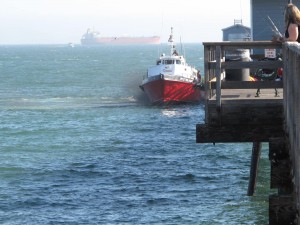
One thing not included in the study is any harm caused by diesel pollutants that come from the “oil boats”, “Capt. T Li” and “Peter Mac”, that regularly pick up men and equipment from the Seal Beach Pier. Whats Up in Seal Beach estimates there are not less than 20 pick-ups and drop offs in each 24 hour period.
The boats pull up next to the pier and NEVER shut off their engines. We’re told that’s the city’s decision.Clouds of noxious fumes affect fisherman and people on the pier a few feet away. Also affected are surfers and boogie boarders nearby and, when the wind is offshore Ruby’s diner 100 feet away.
TODDLERS PLAYGROUND
Most important is the play area for our children. It is only a few hundred yards away and the prevailing winds suck the fumes directly in that direction. When you read EPA reports of toxic fumes you’ll notice there is always an emphasis on what the fumes do to small children and pregnant women.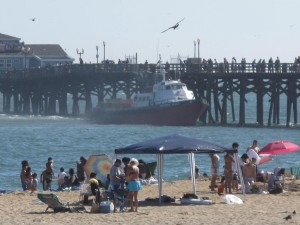
Sometimes the boat is running (and spewing fumes) for considerable periods. The photos above were taken on July 4th and prevailing winds were strong enough that day that the fumes shown are pretty well dispersed and do not accurately show how concentrated they are most of the time. On Independence day the “Peter Mac” was at the pier for almost 45 minutes waiting for ONE person.
TRUCKS CONTROLLED, HARBOR BOATS ARE NOT?
California state law states that a diesel truck operating in the harbor can only idle for 5 minutes….after 5 minutes if it doesn’t shout down it is fined. The oil boats have diesel engines 10 times as big as a diesel truck yet they can run those engines next to an exposed group of holiday beachgoers for 45 minutes!
CHILDREN’S HEALTH STUDY
According to the Clean Air Task Force in diesel engine particulates carry a number of potent carcinogens. In children, particulate matter has also been associated with crib death. A 2004 study showed that particles and nitrogen dioxide have chronic adverse effects on lung development 10-18 year olds leading to deficits in lung function as the children reached adulthood. What’s more, diesel engines also release other gases such as carbon monoxide and nitrogen oxides that form ground level ozone. Results of the California Children’s Health Study suggest that ozone is associated with birth defects and new diagnoses of asthma.
PIER DAMAGE OVERESTIMATED?
Since the oil boats approach from the east side of the pier they are usually being pushed away by the prevailing winds, so the engine is always working hard to push the boat back to the dock. If the boats tied-up at the loading dock they could shut their engines or at least reduce them to “idle mode.”
NO TIE-UP MEANS WORKERS MUST JUMP ON BOARD
The city says that they do not want the ship to tie-up because if they did the operators might bang into the pier and do damage to the pier. (What does the city think happens to the pier when the boat is being constantly pushed away by wave action and has to keep pushing back?) The photo below shows a worker jumping on board.
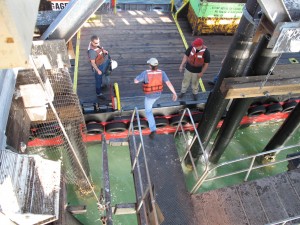
Admittedly a small jump and not a big risk, however, when it is repeated 100 times in 24 hours, sometimes in dark and inclement weather; and often with an exhausted worker at the end of a long day…the risk to injury or death increases exponentially.
We’ve seen senior boat operators who could put a vessel a lot bigger than the oil boats next to a dock as gently as one would stroke a kitten. If the operators did that they could tie-up without any damage to the pier. As it is presently done the boat MUST bump the dock several times because it is constantly being pushed off by wave action and prevailing winds. Even if there was a chance of occasional harder pier bumps the boat operator could easily carry a bond that would cover any possible damage to the pier.
DO WE EVEN NEED THE OIL BOATS AT OUR PIER?
If we don’t allow the boats to use the pier there are lots of other options for them. Alamitos Bay has a usable pier which they use when they can’t come here. Perhap the Belmont Pier ? Huntington Beach has both a helicopter pad and a pier…but maybe Huntington is more conscious of their pier users and doesn’t want the oil boats there. Yes we’d lose some revenue but is the revenue generated enough to justify the risks to the health of our citizens and visitors. Might we be held mutually liable for health risks to nearby residents who are forced to breath substantially more of these carcinogens brought into the city by a contract between the city and boat operator?
NATA provides broad estimates of risk over geographic areas of the country and not definitive risks to specific individuals. The results are best used to prioritize pollutants and areas for further study, not as the sole basis for regulation or risk reduction activities.
Since the 1990 Clean Air Act Amendments, air toxic emissions have decreased by 40 percent from all sources. NATA can be used to help all levels of government target further reductions in air toxics emissions.
FOR MORE INFORMATION :
Diesel and Health in America: The Lingering Threat
http://www.catf.us/publications/view/83
www.epa.gov/oar/toxicair/newtoxics.html
Cukes make you beautiful …and healthy too!
November 21, 2009 by Wilm
Filed under Green Issues, Local News
Comments Off on Cukes make you beautiful …and healthy too!
Want to tighten up those wrinkles, get rid of a hangover, sweeten up your breath, shine your shoes or get rid of headache? Here’s your inexpensive and simple answer!
1.Cucumbers contain most of the vitamins you need every day, just one cucumber contains Vitamin B1, Vitamin B2, Vitamin B3, Vitamin B5, Vitamin B6, Folic Acid, Vitamin C, Calcium, Iron, Magnesium, Phosphorus, Potassium & Zinc.
2. Feeling tired in the afternoon, put down the caffeinated soda and pick up a cucumber. Cucumbers are a good source of B Vitamins and Carbohydrates that can provide that quick pick-me-up that can last for hours.
3. Tired of your bathroom mirror fogging up after a shower? Rub a cucumber slice along the mirror, it will eliminate the fog and provide a soothing fragrance.
4. Grubs and slugs ruining your planting beds? Place slices in a small pie tin and it will be free of pests all season long. The chemicals in the cucumber react with the aluminum to give off a scent undetectable to humans but drive garden pests crazy and make them flee the area.
5. Looking for a fast and easy way to remove cellulite before going out or to the pool? Try rubbing a slice or two of cucumbers along your problem area for a few minutes, the photochemical in the cucumber cause the collagen in your skin to tighten, firming up the outer layer and reducing the visibility of cellulite. Works great on wrinkles too!!
6. Want to avoid a hangover or terrible headache? Eat a few cucumber slices before going to bed and wake up refreshed and headache free. Cucumbers contain enough sugar, B vitamins and electrolytes to replenish essential nutrients the body lost, keeping everything in equilibrium, avoiding both a hangover and headache!!
7. Looking to fight off that afternoon or evening snacking binge? Cucumbers have been used for centuries and often used by European trappers, traders and explores
for quick meals to thwart off starvation.
8. Have an important meeting or job interview and you realize that you don’t have enough time to polish your shoes? Rub a freshly cut cucumber over the shoe,
its chemicals will provide a quick and durable shine that not only looks great but also repels water.
9. Out of WD 40 and need to fix a squeaky hinge? Take a cucumber slice and rub it along the problematic hinge, and voila, the squeak is gone!
10. Stressed out and don’t have time for massage, facial or visit to the spa? Cut up a cucumber and place it in a boiling pot of water, the chemicals and nutrients from the cucumber with react with the boiling water and be released in the steam, creating a soothing, relaxing aroma that has been shown the reduce stress in new mothers and college students during final exams.
11. Just finish a business lunch and realize you don’t have gum or mints? Take a slice of cucumber and press it to the roof of your mouth with your tongue for 30 seconds to eliminate bad breath, the photochemical will kill the bacteria in your mouth responsible for causing bad breath.
12. Looking for a ‘green’ way to clean your faucets, sinks or stainless steel? Take a slice of cucumber and rub it on the surface you want to clean, not only will it remove years of tarnish and bring back the shine, but it won’t leave streaks and won’t harm you fingers or fingernails while you clean.
13. Using a pen and made a mistake? Take the outside of the cucumber and slowly use it to erase the pen writing, also works great on crayons and markers that the kids have used to decorate the walls!
Pass this along to everybody you know who is looking for better and safer ways to solve life’s everyday problems.
Construction Underway on the First Registered U.S. Green Building LEED (Leadership in Energy and Environmental Design) Homes on the California Coastline
October 24, 2009 by admin
Filed under Green Issues, Local News
Comments Off on Construction Underway on the First Registered U.S. Green Building LEED (Leadership in Energy and Environmental Design) Homes on the California Coastline
Laguna Beach has long been a source of inspiration for artists (the Plein Air school of landscape painting), television producers (MTV’s Laguna Beach: The Real Orange County), and other innovators.
Now, this picturesque resort town is the setting for a major development in the eco-building movement, as Tresor Properties – a premier Laguna Beach-based real estate investment, construction and brokerage firm – builds the first U.S. Green Building Council LEED (Leadership in Energy and Environmental Design) for Homes registered project on the California coastline.
With these two luxury oceanfront residences, Tresor Properties is pursuing the U.S. Green Building Council’s highest “green” building rating – a Platinum designation. According to the Certified Projects Database at USGBC.org, there are only 81 LEED for Homes-certified Platinum projects completed in the world as of October 2009.
Tresor Properties’ “Pursuit of Platinum” project is newsworthy not only for bringing a new level of eco-friendly homebuilding to the West Coast, but also for raising the bar for green living.
“With our Laguna Beach oceanfront residences we’re making a clear statement that you don’t have to sacrifice luxury and quality when you build green,” says Ken Fischbeck, Vice President of Construction and Founding Partner, Tresor Properties. “Not only are we building to the highest level of energy efficiency and environmental sensitivity, we’re also building with functionality, longevity, quality and beauty in mind.”
Other luxury home brands that are committed to sustainability have joined the “Pursuing Platinum” project, demonstrating their support of Tresor Properties ushering in a new era of luxury green homebuilding. These firms include renowned German kitchen manufacturer Poggenpohl and Italian door and window makers STR Infissi.
“Combining high-end design with state-of-the-art building technologies is our passion, and that is why we are partnering with Tresor,” says Ted Chappell, President of Poggenpohl U.S., Inc. “These homes will be among the greenest in the world and the design elements are stunning.”
Other “Pursuing Platinum” project sponsors include Coastal Concrete, Hillcrest Framing, and B and D Plumbing.
The two U.S. Green Building Council Platinum LEED registered homes-in-progress are located at 990 and 992 Ocean Front, in the heart of Laguna Beach’s sought-after “Village” district. Gracing two prime parcels of oceanfront land, the residences will feature views of the coastline, crashing whitewater and Catalina Island. Designed by prominent Laguna Beach architect Mark Singer – who is known for creating award-winning contemporary homes inspired by nature – the homes will encompass 3,650 square feet and 4,500 square feet, respectively, of casually elegant beachfront living. They also will feature expansive oceanfront terraces, private steps to the beach, pools, spas, elevators, three-car garages and state-of-the-art home automation technology. In addition to their anticipated receipt of the USGBC Platinum LEED designation, the homes also are planned to exceed California’s current strict Title 24 requirements for energy efficiency building by more than 58 percent.
“High-end homebuyers have been waiting for this product – a house that blends luxury living with a beachfront location and environmental design,” says real estate agent Marcus Skenderian of eco-brokerage Surterre Properties in Laguna Beach, who is part of a team representing the homes for sale. “We already have an impressive roster of interested clients and the buzz surrounding the properties is tremendous.”
Estimated completion for the homes is mid-2010. Both residences are offered for sale by Surterre Properties, a leading luxury real estate firm that also is a green company and the only eco broker in Orange County. For more information, interested parties may contact Marcus Skenderian of Surterre Properties at 949.295.5758 or visit his website at www.skenderianproperties.com
2010 Mileage Report…8 mpg sound OK to you?
October 15, 2009 by Wilm
Filed under Events, Green Issues
Comments Off on 2010 Mileage Report…8 mpg sound OK to you?
This year’s new cars have some surprising mileage numbers. 8, 9, 10 and 11 miles to the gallon!
The EPA has released their annual fuel economy guide. There are lots of autos with greatly improved mileage. Alas, there are still a few that don’t seem to get the message or cannot improve their mileage number without compromising their goal?
A Chevy van that gets 13 mpg IS NOT the worst by any measure. Not surprisingly most of the cars with bad numbers seem to be aimed at an audience of Marie Antoniette’s …. Those with a sort of “Let ’em eat cake” attitude.
When discussing the 2010 mileage report EPA Administrator Lisa Jackson said: “Every year, consumers use the Fuel Economy Guide to find clean, efficient, cost-effective vehicles that meets their needs and their budgets. It’s an easy, accessible resource for everyone, and helps us cut harmful pollution from the air, and save money for American drivers.”
Fuel-efficient models come in all types and sizes, so consumers can save thousands of dollars over a vehicle’s lifetime without sacrificing performance. Model year 2010 fuel economy leaders include a wide range of hybrid models, from compact cars to sport-utility vehicles. “Fuel economy is about both saving energy and saving money,” said Energy Secretary Steven Chu. “Buying fuel efficient vehicles – like the many hybrid technologies featured in this year’s Fuel Economy Guide – helps limit carbon pollution, lessen our dependence on foreign oil, and reduce driving costs for American families.”
Each vehicle listing in the Fuel Economy Guide provides an estimated annual fuel cost. The estimate is calculated based on the vehicle’s miles per gallon (mpg) rating and national estimates for annual mileage and fuel prices. The online version of the guide allows consumers to input their local gasoline prices and typical driving habits to receive a personalized fuel cost estimate.
Fuel efficiency is important for reducing carbon dioxide (CO2) and other greenhouse gases that contribute to global climate change. One of the most important things consumers can do to reduce their contribution to climate change is to buy a vehicle with better fuel economy.
The Fuel Economy Guide continues to be available to mobile users (fueleconomy.gov/m), and is readily accessible from a mobile device, smart phone, or personal digital assistant (or PDA).
Joint DOE/EPA Fuel Economy website for detailed information on fuel economy, including a complete version of the Fuel Economy Guide: http://www.fueleconomy.gov
The 2010 fuel economy leaders within each class as well as the lowest fuel economy models: http://www.epa.gov/fueleconomy/basicinformation.htm
Jobs, jobs, jobs…and in Seal Beach!
October 10, 2009 by Wilm
Filed under Green Issues, Local News
Comments Off on Jobs, jobs, jobs…and in Seal Beach!
Here you go/ A new Marshall’s, More openings at Amonix and also at Clean Energy Fuels.
Some of these we may have mentioned before but it never hurts to keep going in and letting people know that YOU REALLY WANT THE JOB!
FOR MORE INFO GO TO:www.oc180news.com/article/West_Orange_County_Features/West_OC_Business_and_Jobs/Jobs_and_Business_Update/18606